Compact microplate reader for 96-well assays, compatible with our ELISA plates: take the lab into your hands!
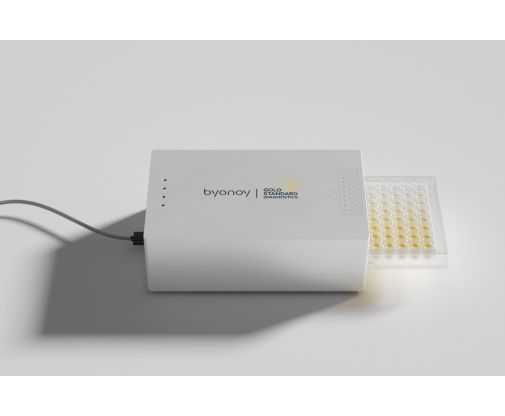
The footprint of the GSD Absorbance 96 is almost as small as the microplate itself, thereby fitting into every lab, saving valuable bench space and providing unprecedented flexibility.
GSD Absorbance 96 is a new category of plate readers with the mission to simplify the workflow in the laboratory. The small size of the reader, in combination with the unique open design, leads to an entirely new user experience. A simple USB connection provides both the power supply and access to the analysis software via plug-and-play.
Key Benefits:
Highly robust with small footprint
Delivers precise and accurate results
Easy transportation and flexibility
7x smaller than the smallest comparable reader
Maintenance-free user experience
96 individual detection units enabling simultaneous signal detection
Extremely fast photometric measurements
Variety of available wavelength combinations
No license fee for software use
Product Information
Detection method
Absorbance
Detection mode
Endpoint, kinetic
Microplates types
96-well microplates
Light source
Up to 4 LEDs
Detector
96 Photodiodes
Wavelength selection
Example combinations (FWHM 10 nm): 450, 492, 562, 620 nm / 405, 450, 540, 630 nm / 492, 562, 605, 650 nm. Other filter combinations in the range of 400–1000 nm possible.
Photometric range
0.0–4.0 OD
Linearity
405 nm: ≤ 1.5 % from 0.0–2.0 OD; ≤ 3.0 % from 2.0–3.0 OD≥ 450 nm: ≤ 1.0 % from 0.0–2.0 OD; ≤ 1.5 % from 2.0–3.0 OD
Accuracy
405 nm: ≤ 1.5 % + 0.010 OD from 0.0–2.0 OD; ≤ 3.0 % + 0.010 OD from 2.0–3.0 OD≥ 450 nm: ≤ 1.0 % + 0.010 OD from 0.0–2.0 OD; ≤ 1.5 % + 0.010 OD from 2.0–3.0 OD
Reproducibility
≤ 0.5 % + 0.005 OD from 0.0–2.0 OD; ≤ 1 % + 0.010 OD from 2.0–3.0 OD
Resolution
0.001 OD
Read time
Dow to 3 sec. at single wavelength
Data output
USB 2.0 interface with PC
Dimensions
9.6 x 15.4 x 5.5 cm (W x L x H)
Weight
900 g
Power supply
USB connection 5 V
Power consumption
2.5 Watts
Operating systems
Microsoft Windows, macOS
Measurement modes
Endpoint, Kinetic
Evaluation methods
Quantitative, Qualitative
Regression methods
Point-to-Point, Linear, Four Parameter Logistic (4PL), Five Parameter Logistic (5PL)